Field notes for forensic engineers and expert witnesses
Can an expert witness use AI?
Yes, with care. AI organizes the case file. The expert still forms the opinion.
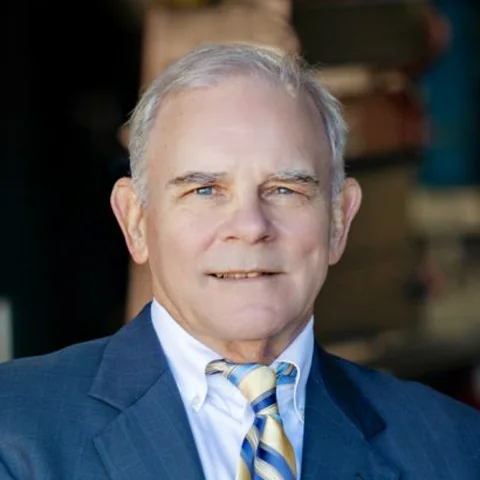 With Raymond Thompson, PhD, PE, founder of Vista Engineering. Published by KnowledgeXpert,
Why are courts watching how experts use AI?
Case files keep getting bigger
Judges are paying attention
Your AI chats can be subpoenaed
Where should AI stop? At the opinion.
| Stage | AI | You |
|---|---|---|
| Case file | Takes it all in | Decide what belongs |
| References | Reads only what you add | Choose what you trust |
| Record | Builds the timeline | Review the conflicts |
| Hypotheses | Counts the evidence | Write them |
| Notes | Keeps the source | Decide what is pertinent |
| The opinion | Nothing | Form it |
The five rules Raymond works by
Pictured: his tool, KnowledgeXpert’s Forensic Workbench, on a demo case from the public NTSB record of the 2018 Miami bridge collapse.
-
One case: every person, party and document connected. Rule 1. One case, one knowledge base
How should an expert witness organize a case file?
Everything on the matter in one place. Trusted references kept separate.
“It doesn’t go out and find any noise or cross talk between different cases.”
Everything he receives on a matter goes into a single case knowledge base. Reference material he trusts sits in separate knowledge bases that he brings in only at the analysis stage. Nothing comes from the open web unless he turns it on.
“I have one knowledge base for that case, and everything on that case goes in that knowledge base. Because I know it’s a welding failure and there’s metallurgy involved, I’ve got two other knowledge bases, one on welding and one on metallurgy. It doesn’t go out and find any noise or cross talk between different cases.”
Raymond Thompson -
A fact opens at its source: page 4 of the NTSB update. Rule 2. Every fact points back to its page
How do you check what AI says about a case file?
Every fact points to its page. Then you read the page.
“A hallucinated fact or a hallucinated reference.”
Each answer carries a citation that opens the source document at the page it came from. He reads the page, then agrees, disagrees or goes deeper.
“being able to ask a question, then find that document in your ton of documents and have it bring up the page and highlight the text. Then you can either agree with it or disagree with it and move on, or go deeper.”
Raymond Thompson“The legal challenges to experts’ use of AI that have drawn a lot of attention are things experts have put into testimony, and then it’s been found out that it’s been hallucinated. A hallucinated fact or a hallucinated reference.”
Raymond Thompson -
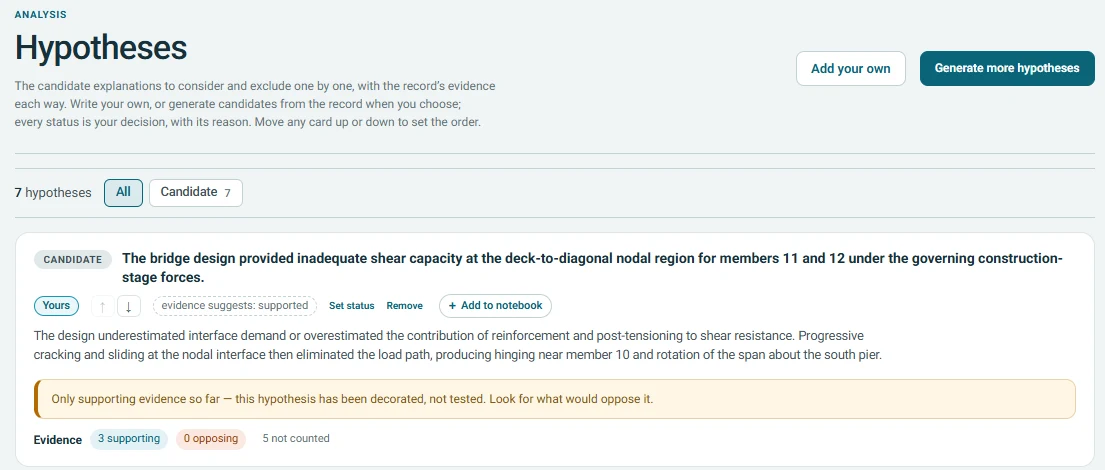
Support with nothing against it: decorated, not tested. Rule 3. You write the hypothesis. The software tests it.
Can AI write an expert witness’s hypothesis?
Not in Raymond’s practice. He writes it. The software tests it.
“We don’t ask AI to create the hypothesis, which would be similar to creating an opinion.”
The hypothesis list starts empty. He writes his own, and the software sorts the record into evidence that supports, opposes or is neutral to each one. Candidates can be generated when asked, and he does not ask. Support with nothing tested against it is called out as decorated, not tested.
“Daubert and Frye want you to use the scientific method: a hypothesis, testing the hypothesis, then conclusions or opinions. We don’t ask AI to create the hypothesis, which would be similar to creating an opinion. But AI can do a great job analyzing your hypothesis and telling you if it sucks or not.”
Raymond Thompson -
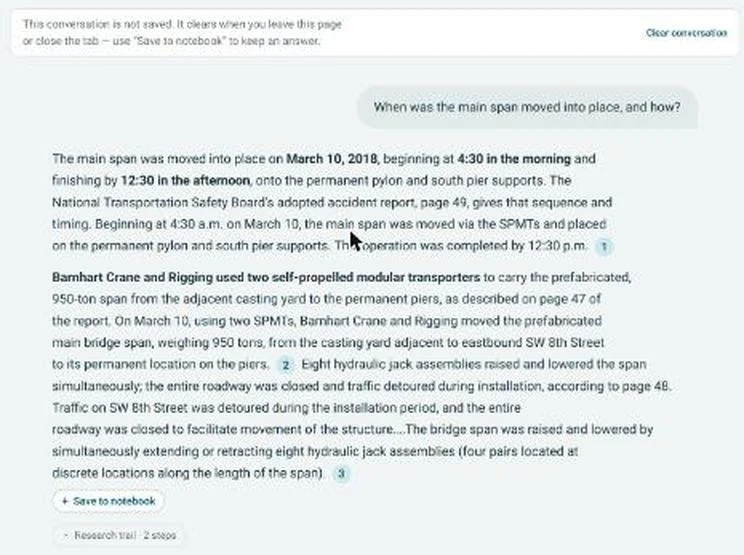
Nothing kept by default. What is pertinent goes to his notebook. Rule 4. Keep what is pertinent, whether or not it supports you
What should an expert keep from an AI chat?
Whatever is pertinent, including what cuts against the opinion.
“When my chat chain gets subpoenaed, what’s going to be in it are the things pertinent to my analysis and opinions.”
Case chat reads only the case files, and it does not persist by default. If he wants to keep a chat discussion or answer, he saves it to a case notebook. Everything saved still points to its source. The test for what to keep is the one that applies to any case file. What to keep is the expert’s ethical call, not the software’s, much like a discussion with a colleague about a case.
“For the last three years I’ve been checking ChatGPT against our knowledge base answers, and it’s always throwing in unsolicited comments and opinions, no matter how much you try to tell it not to. When my chat chain gets subpoenaed, what’s going to be in it are the things pertinent to my analysis and opinions, and not things that are not pertinent.”
Raymond Thompson -
A case chronology built from the documents, conflicts ringed. Rule 5. Spend the time on depth, not volume
Where does AI save an expert witness time?
In the organizing: dates, duplicates and who said what.
“Now I can really concentrate on the important parts, which are the analysis.”
The organizing work is where he says the hours go: finding dates, reconciling documents copied under different names, tracing who said what. The timeline rings dates that conflict, and likely duplicates are listed for his review rather than merged.
“It takes away a lot of the nibbling time. Now I can really concentrate on the important parts, which are the analysis. I can go deeper. I can spend more time making sure I haven’t made any mistakes, because that’s what ruins a client relationship. That’s what ruins a career.”
Raymond Thompson
“It just makes a good expert better.”
What should an expert witness document when using AI?
Work back from the deposition. Illustrative questions, not from any case.
“Did you use AI?”
The tool and each task
“What could it read?”
The document set, with the open web on or off
“Where is this from?”
The source page, read by you
“Whose hypothesis is this?”
Yours, with evidence both ways
“What cut against you?”
Every pertinent output you considered
“Can we see your prompts?”
What you agreed with counsel
What is prompt hygiene for expert witnesses?
Write every prompt as if opposing counsel may read it. Courts split on this in 2026.
Avoid: Confirm that the weld failed from fatigue.
Better: What does the record say about the fracture surface? Cite each page.
Avoid: How do we rebut the other side’s expert?
Better: List where the opposing report and the test data disagree, with pages.
Avoid: Write my opinion on causation.
Better: Sort the record by whether it supports, opposes or is neutral to my hypothesis.
See it on a public case

Questions experts ask about AI
Do expert witnesses have to disclose AI use?
It depends on the court and the engagement. A retained expert’s report under Federal Rule 26 has to state the facts or data considered, and AI output the expert relied on may fall within that. Agree on AI use with retaining counsel early.
What should an expert witness document when using AI?
Enough to explain your own method: the tool and each task you used it for, the document set it could read, the source page behind each fact you rely on, your hypotheses with the evidence for and against, any AI output you considered, and what you agreed with retaining counsel. Rule 702 asks whether the opinion reflects a reliable application of reliable methods.
What is prompt hygiene for expert witnesses?
Writing every prompt as if opposing counsel may read it. Ask about the record, leave speculation, strategy and draft opinions out, keep client files out of public chatbots, and keep research, deposition preparation and drafting apart. Settle privilege and disclosure questions with retaining counsel before the work starts.
Can AI form an expert opinion?
Raymond Thompson’s answer is no. He does not ask AI to create the hypothesis, which he says would be similar to creating an opinion. The opinion stays with the expert, and every fact behind it points back to a page.
Can an expert’s AI chats be subpoenaed?
They can be, and experts should plan for it. Raymond works on the basis that a subpoena for the case file can reach chat discussions too. Federal courts split on prompts in 2026, so ask retaining counsel how the rules apply to your engagement.
What do Daubert and Frye have to do with AI?
Daubert and Frye are the standards courts use to decide whether expert testimony comes in. As Raymond puts it, they want the scientific method: a hypothesis, testing the hypothesis, then conclusions or opinions. An expert who uses AI still has to show that method was their own.
How do you organize a large case file for expert review?
Put every document into one case record, tagged with its parties, dates and source. Build the case chronology from the documents, keep likely duplicates listed for review rather than merged, and bring in reference material only at the analysis stage.
Who is Raymond Thompson?
Raymond Thompson, PhD, PE, is a forensic engineer and expert witness based in Birmingham, Alabama, and a Fellow of the National Academy of Forensic Engineering, ASM International and the American Welding Society. He founded Vista Engineering about 26 years ago. Its engineers, including two PhDs, are in litigation daily, primarily product liability with insurance work alongside. He has used KnowledgeXpert since its early chat versions and helped shape its Forensic Workbench.
What is the Forensic Workbench?
The Forensic Workbench is KnowledgeXpert’s app for forensic engineers and expert witnesses. It organizes a case file, ties each fact to its page and tests the hypotheses you write. It does not form the opinion.
Educational, not legal advice. Rules differ by court. Ask retaining counsel.